OmniDocBench
v1.6 · diverse documents
Δ+0.64
TECHNICAL REPORT COVERAGE → CAPABILITY
From Coverage to Capability for Robust
End-to-End Document Parsing
WeChat Vision Team, Tencent Inc. * Equal contribution. † Project leader. ‡ Corresponding author.
Document parsing converts document images into structured content and requires reliable performance across diverse layouts and acquisition conditions. We present WeVisDoc, a two-stage data-centric framework for robust end-to-end document parsing. Stage I broadens semantic, structural, and appearance coverage; Stage II uses residual-error diagnostics to guide targeted data construction and reallocation.
01 / END-TO-END LEADERBOARD
WeVisDoc-4B against the strongest reported end-to-end specialist on each benchmark view. Every value is the Overall score.
v1.6 · diverse documents
source-traceable clean pages
10 algorithmic degradations
4 physical capture chains
Overall ↑ · The comparison baseline is named per row. The visual axis begins at 60 to make small score differences legible.
STAGE II EFFECT · 4B
Capability-aware refinement preserves clean-page accuracy while concentrating the largest gain on real captures.
02 / INTERACTIVE RECOVERY LAB
Twelve selected pages expose concrete failure modes—not just final scores. Switch benchmark tracks, inspect the marked source, and compare the serialized outputs.
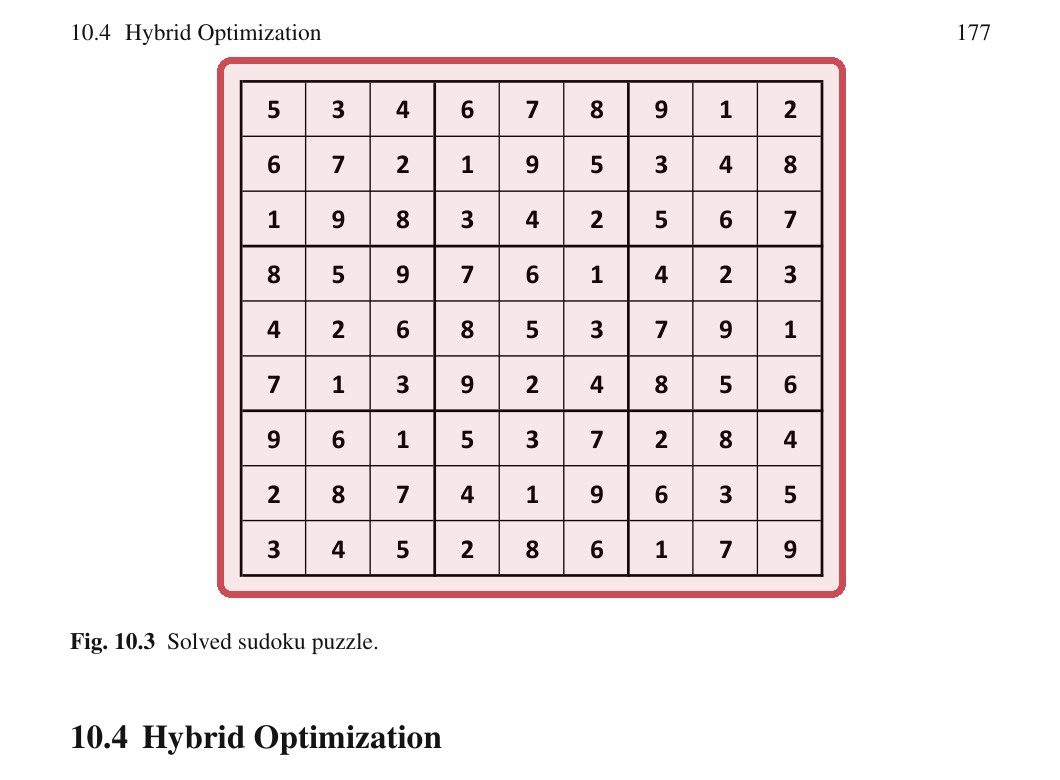
Stage I omits the 9×9 Sudoku grid; Stage II restores the complete table.
Fig. 10.3 Solved sudoku puzzle.

## 10.4 Hybrid Optimization
Hybrid methods may be required to solve particularly difficult real-world optimization problems. Implementation of hybrid methods typically requires non-trivial scripting
…
<table><tr><td>5</td><td>3</td><td>4</td><td>6</td><td>7</td><td>8</td><td>9</td><td>1</td><td>2</td></tr>
…
<tr><td>3</td><td>4</td><td>5</td><td>2</td><td>8</td><td>6</td><td>1</td><td>7</td><td>9</td></tr></table>

Fig. 10.3 Solved sudoku puzzle.

### 10.4 Hybrid Optimization
…
03 / COVERAGE TO CAPABILITY
The architecture stays fixed. What changes is where useful target-token mass is allocated.
STAGE I · SUPPORT
Source-balanced heterogeneous data combines semantic coverage with structure-preserving appearance synthesis.
DIAGNOSIS · RESIDUALS
Held-out probes reveal coherent failure clusters across structure, content, language, and acquisition conditions.
STAGE II · ALLOCATION
Clipped residual-aware weights and curated hard examples strengthen weak regions without displacing natural data.
# Heading$$ E = mc² $$<table>…</table>Text, formulas, tables, and reading order stay in one inspectable sequence.
04 / OPEN RELEASE
Start with the compact 2B checkpoint or use the 4B checkpoint for the strongest reported results. Code and tutorials are available on GitHub.